


The Breakdown: Mainstream pundits blame egos, work rate, and lack of hunger. But step inside the analysis room, and the truth is obvious: when you trade tempo control for pure vertical speed, your entire system fractures. Here is the technical post-mortem on why Real Madrid’s attack stalled without Toni Kroos—and the structural blueprint needed to fix it.
For a decade, Real Madrid possessed the most reliable first-phase progression mechanism in world football: Toni Kroos dropping into the left half-space between the left center-back and the left-back.
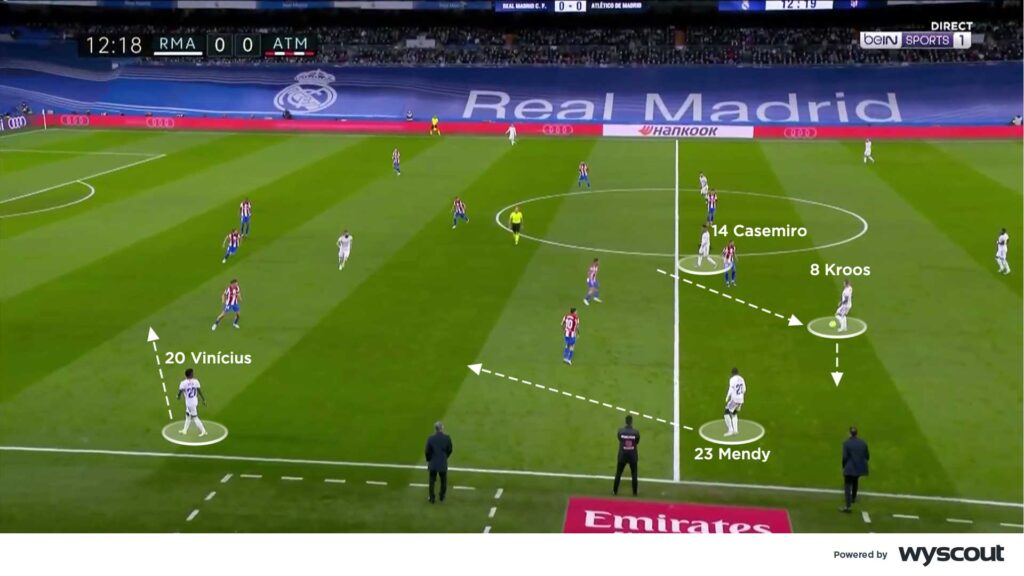
Why This Mechanism Worked:
1. 180-Degree Panoramic Vision: By dropping outside the opposition’s first pressing line, Kroos faced the entire pitch forward. He was immune to blind-side pressure.
2. Fixing the Opponent’s Press: His positioning forced the opponent’s right winger into a tactical dilemma: step up and leave the full-back open, or tuck in and allow Kroos uncontested distribution.
3. Pacing the Line-Breaking Pass: Kroos didn’t just pass; he dictated the weight and tempo of the delivery, signaling to the receiver whether to turn, play a one-touch bounce pass, or switch play.
The Current Reality Without Him:
Aurélien Tchouaméni, Federico Valverde, and Eduardo Camavinga possess world-class physical, defensive, and ball-carrying profiles. However, none of them are natural deep controllers.
– Body Shape Limitations: When receiving from center-backs under pressure, dynamic box-to-box midfielders often receive with closed body profiles (facing their own goal), making them vulnerable to blind-side pressing
traps.
– Predictable Escape Routes: Without a deep playmaker dropping to form a clean back-three in build-up, opponents set aggressive man-oriented pressing traps against Madrid’s center-backs. Antonio Rüdiger and Éder Militão are routinely forced into speculative direct balls down the flanks or safe, horizontal circulation that allows the opponent to shift their defensive
block effortlessly.
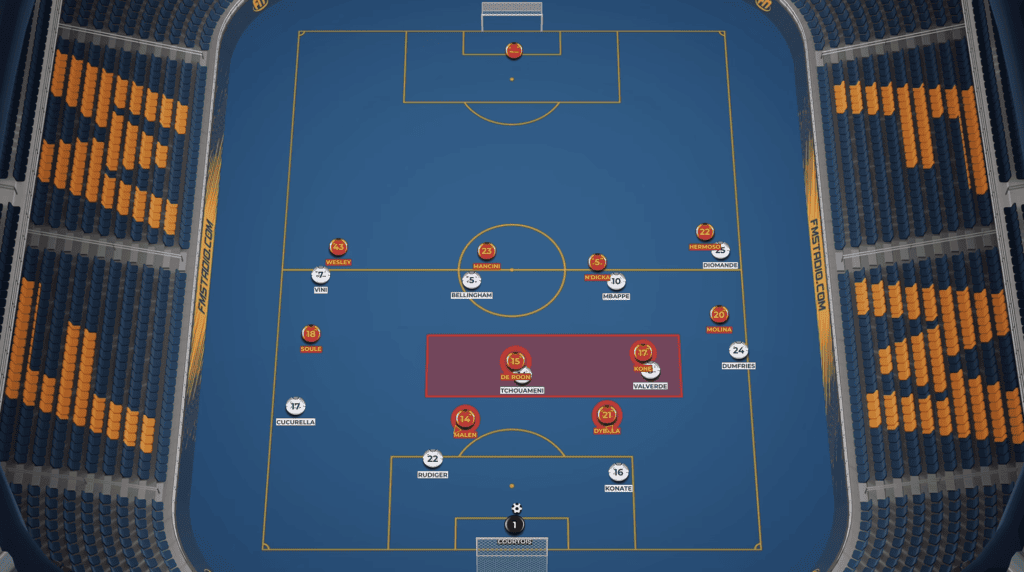
In coaching, we emphasize that space is not static; space is created by moving the opponent.
When you assemble Vinícius Júnior, Kylian Mbappé, and Jude Bellingham, you possess arguably the most lethal transitional threat in football. All three players thrive on forward momentum, vertical runs, and attacking defenders at speed.
However, against a stubborn 5-3-2 or 4-5-1 low-block, pure verticality becomes self-defeating.
The Mechanical Breakdown:
– The Role of the Pausa: A controller uses the pausa (holding the ball for an extra half-second, circulating horizontally) not to waste time, but to lure the opponent’s midfield line forward. When the opponent steps up 5 to 8 meters to close down the metronome, passing lanes into the half-spaces instantly appear.
– The Rush into Congestion: Without that patience deep, Madrid rushes play forward prematurely. Because the ball travels vertically before the opponent’s block has been destabilized, Vinícius and Mbappé receive the ball against a set, compact defensive line with zero depth to exploit.
– Interior Traffic Jams: Jude Bellingham, whose best quality is arriving late into the box from deep blind spots, is instead forced to occupy congested interior pockets permanently to act as a false connector. His goal threat
decreases in direct proportion to how early he has to show for the ball.
Perhaps the most critical failure occurring when a team attacks too quickly is the breakdown of its Rest-Defense (the defensive structure maintained behind the ball while in possession).
The Tactical Chain Reaction:
1. Possession Duration Dictates Structural Positioning: In a controlled positional attack, a team requires 6 to 10 seconds of settled possession to allow their rest-defense structure—typically a 3-2 or 2-3 setup—to step up to the halfway line and squeeze the pitch.
2. Premature Vertical Deliveries: When Madrid attacks too directly, they lose the ball after only 2 or 3 passes. The attacking line is deep in the opponent’s box, but the rest-defense unit hasn’t had time to push up and lock down the central corridors.
3. The Transitional Chasm: The result is a 30-to-40-meter gap between the forwards and the defensive unit. Opponents winning the second ball do not face a counter-press; they turn into empty green grass, isolating Madrid’s
center-backs in direct, open-field duels.
To resolve this imbalance, a coaching staff cannot simply instruct direct players to play like Toni Kroos. The solution must be systemic, not individual:
1. Implement an Inverted Full-Back in First-Phase Build-Up
If the double pivot cannot orchestrate play from deep, Madrid must invert a full-back into the central corridor during build-up to create an asymmetric 3-2 structure.
– By placing an interior passer next to the holding midfielder, you generate numerical superiority (3v2 or 4v3) against the opponent’s first two lines, relieving pressure on the center-backs.
2. Re-Position Arda Güler or Bernardo silva as a Deep Progressors
Rather than viewing Arda Güler or Bernardo Silva purely as an interior #10 or right winger, their optimal tactical aspect mirrors that of Luka Modrić: dropping into the second phase of build-up. their scanning frequency, hip mobility to turn under pressure, and weight of pass provide the technical disguise this midfield currently lacks.
3. Establish the “Five-Second Rule” for Circulation
Implement a tactical constraint in possession: No line-breaking pass into the front three until the ball has traveled through at least one horizontal switch across the central axis.
– This deliberate circulation forces the opponent’s compact block to shift laterally, loosening their defensive distances and opening the half-space channels before Mbappé and Vinícius make their runs.
Modern football loves physical output, electric ball-carriers, and instant transitions. But the tactical reality remains unchanged: Speed without structural pause is just chaos.
You cannot unlock the world’s most dangerous frontline if the platform beneath them is unstable.
Now I want to hear from you:
– How would you solve Madrid’s build-up dilemma? Would you invert a fullback, drop Arda Güler deep, or alter the shape entirely into a back three?
Drop your tactical take in the comments below, or share this breakdown with a fellow analyst.
Are you a professional player, agency, or club looking to gain a competitive tactical edge? From bespoke opponent scouting and set-piece design to individualized video analysis that translates theory into pitch execution, explore our work and consult with us at csalah.com.
